
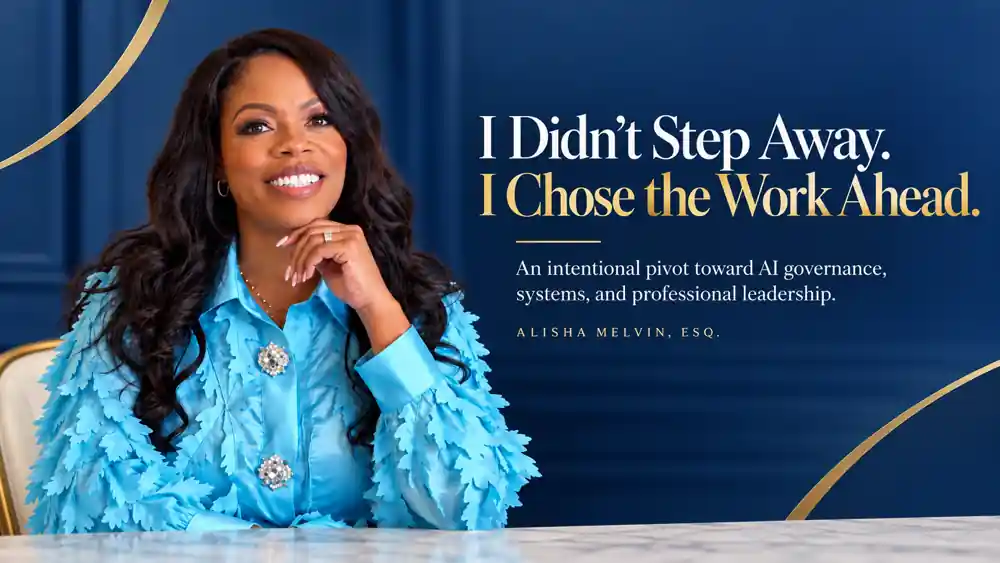
There is a difference between stepping back and becoming more selective.
Over the last two years, I have become much more selective.
I made an intentional decision to stop taking on extra work, committee assignments, and professional obligations simply because I was invited, qualified, or capable of doing them. If the work did not align with improving the systems inside my businesses, deepening my understanding of artificial intelligence, strengthening governed use of technology, or expanding the work I was already doing in law, real estate, education, and professional training, I began saying no.
That was not disengagement.
It was focus.
And for me, that focus became especially important because artificial intelligence was moving too quickly for me to treat it like a side interest.
I could not afford to get left behind.
I work in law and real estate.
Both involve consequential decisions. Legal work, in particular, involves confidential information, client trust, professional obligations, judgment, and data that cannot be treated casually.
As AI systems became more capable, my concern was not simply whether I could use them.
I wanted to understand what they were doing.
What information was being sent where? What should never leave a controlled environment? When should human review be mandatory? How do you use automation without weakening supervision? How do you improve speed without sacrificing accuracy, confidentiality, provenance, or accountability?
Those questions became impossible for me to ignore.
I believe deeply in protecting client data. I believe professionals have an obligation to understand the systems they use. And I knew that if AI was going to touch legal work, real estate operations, education, marketing, client communications, research, or business systems, I needed to understand it at a level beyond simply knowing how to prompt a chatbot.
So I began to study it seriously.
Then I began to build with it.
Then I began to govern how I used it.
The pivot started in 2025.
By 2025, the direction was becoming clear.
I had spent years saying yes to service, leadership, committees, boards, teaching, legal work, real estate, business development, and professional organizations.
Much of that work mattered to me.
But capacity is finite.
I ended my service on the Greater Lehigh Valley Association of REALTORS® Grievance Committee in December 2025 and chose not to rejoin. I also made decisions not to pursue or continue other opportunities that would have required time without advancing the work I believed needed my attention most.
One of those decisions was turning down an invitation to join my law school alumni association after being selected through an extensive process.
That was not an easy kind of opportunity to decline.
But I had become clear about what I wanted my next chapter to require.
I did not need another title simply because I could earn one.
I needed time to build.
I did not leave law or real estate. I added AI to everything I do.
This is the part that matters most to me.
My pivot toward AI was never a pivot away from my professions.
It was a decision to bring AI, systems thinking, and governance into the work I already understood.
In 2026, I helped MetroTex record a required SAE course centered on marketing, and I was able to incorporate AI and AI governance issues into that education.
I am also working with the Residential Real Estate Council, home of the CRS designation, on its probate programming.
That is exactly the kind of work I want more of.
I do not want AI education floating in a vacuum, disconnected from professional practice.
I want to talk about AI where professionals actually work.
In legal practice. In real estate. In probate. In marketing. In client service. In operational systems.
In the places where a technology decision can create real efficiency, real risk, or both.
I am not interested in being a person who only talks about AI.
I use it.
Every day.
I use AI inside my actual businesses, actual workflows, actual research, actual content systems, actual operational decisions, and actual problem-solving.
That experience has changed how I teach it.
It has also changed what I believe professionals need.
They do not need another person telling them AI is revolutionary.
They can see that.
They need someone who can help them understand implementation.
What belongs in the workflow? What does not? What should be automated? What should remain human? How should knowledge be structured? How do you protect sensitive information? How do you verify outputs? Where do approval gates belong? How do you train a team to use the tools without allowing the tools to run the team?
That is where my interest has moved.
Hands-on implementation. Governed usage. Training. Speaking. Systems.
Some priorities required protected time.
There were also projects I simply decided had to get finished.
My book was one of them.
So was building out AMELIA and the way she introduces tools, systems, and AI concepts in a practical way.
Those priorities required time that could not also belong to every committee, every invitation, every board, every new matter, and every opportunity that arrived because I had a history of saying yes.
At some point, focus has to become visible in the calendar.
I began protecting mine.
AI is moving too fast for passive expertise.
Artificial intelligence is moving at a speed that is difficult to compare with most professional changes I have experienced.
That does not mean professionals should panic.
It means we have to pay attention.
For lawyers, brokers, educators, and business owners, passive awareness is not enough.
You cannot govern what you do not understand.
You cannot protect data if you do not know how a system handles it.
You cannot supervise an automated process you have never examined.
You cannot determine whether AI improved the work if you never understood the work in the first place.
That is why I keep coming back to the same principle: Experts Drive AI.
The technology may accelerate the process.
The expert remains responsible for the judgment.
My next chapter is about implementation.
I am still an attorney.
I am still a real estate broker.
I still teach.
I still serve where the service aligns.
But I am far more intentional about the work I accept and the roles I take on.
My focus is increasingly centered on the intersection of professional expertise, artificial intelligence, systems, governance, implementation, education, and responsible use.
I want to help professionals understand not only what these tools can do, but how to use them inside real businesses with real obligations.
I want to keep building.
I want to keep testing.
I want to keep learning.
And I want to teach from use, not theory.
I did not throw away the work I spent decades building.
I added AI to it.
Then I made room to understand what that actually means.
That pivot was intentional.
And I believe it was necessary.