
You Don't Need Somebody Else's AI System. Build One That Works for You.
Stop collecting tools. Start designing intelligent systems around your expertise, your work, and your responsibilities.
By Alisha Melvin, Esq. · November 9, 2026 · AI Governance · Business Systems
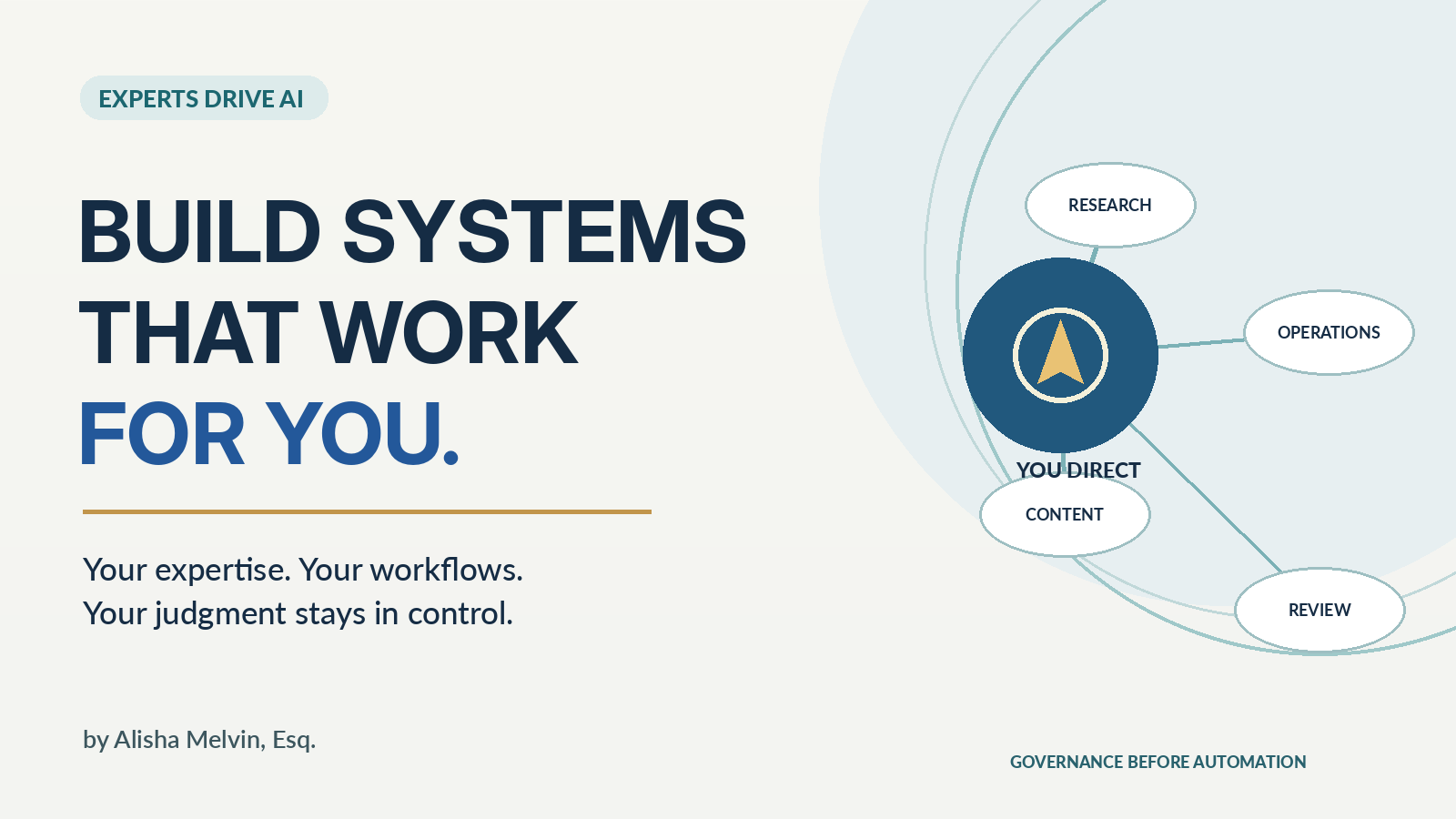
Everywhere you look, somebody is selling an AI system.
A collection of agents. A ready-made workflow. The next tool that is supposed to change your business overnight.
But I keep coming back to one question: Does that system actually understand your business?
Your expertise? Your clients? Your processes? Your responsibilities? The legacy you are trying to build?
Or are you spending money trying to make your business fit into somebody else's system?
The Expensive Mistake of Collecting AI Tools
Everywhere I look, someone is selling an AI system, a bundle of agents, or a shortcut that promises to transform a business. Some are genuinely useful. Others are impressive demonstrations that never make it into the everyday work.
The real question is not whether an AI product is powerful. It is whether it understands the work you actually need done. Does it support your clients, your processes, your standards, your obligations, and your objectives? Or are you rearranging your entire business to accommodate somebody else's demonstration?
Buying another tool without first identifying the problem can create a new expense, another login, and one more disconnected place where information lives. That is not transformation. It is accumulation.
Your Expertise Is the Starting Point
AI can draft a business plan, outline a workflow, summarize documents, and suggest next steps. Those capabilities are meaningful. But ready access to a strategy is not the same as knowing whether that strategy fits your circumstances.
As an attorney, real estate broker, and educator, I know the difference between producing an output and taking responsibility for a decision. A proposed process must account for context, exceptions, professional duties, confidentiality, and the consequences when something goes wrong.
That is why I say Experts Drive AI. Your experience and judgment must define the work before software is invited to perform any part of it.
Build the System Around the Work, Not the Other Way Around
When I say build your own AI system, I am not suggesting that every business owner must become a software developer or build an entire technology stack from scratch. Existing tools, reputable platforms, and outside implementation expertise may be exactly what you need.
What you should own is the architecture of your work: the steps that matter, the knowledge your business relies on, the rules that govern decisions, the information access you authorize, and the ability to change tools without losing control of your processes.
Start with one recurring problem. Write down how you handle it today. Identify where information enters, where work gets stuck, what must be reviewed, and what success looks like. Only then decide whether the answer is a better process, simple automation, an AI assistant, or an agent.
An AI Agent Needs a Job Description
An agent should not exist simply because an impressive video convinced you that you need one. It should have a defined purpose, a narrow scope, a reliable information source, clear permissions, and measurable performance.
An intake assistant might organize an inquiry for human review. A research assistant might gather and summarize source material. An operations assistant might track an authorized task and flag an exception. None of those roles automatically gives the agent authority to contact clients, make commitments, spend money, or make professional decisions.
More agents can mean more complexity, duplicated responsibilities, and unnecessary risk. Better-defined agents can mean less friction and more useful support.
Governance Before Automation
Efficiency without governance can create liability. An AI system that works quickly but exposes confidential information, takes unauthorized action, or produces unsupported conclusions is not a successful system.
Before connecting an agent to real work, ask: What data can it see? What may it change? What must it never do? When must it ask for approval? Who reviews its work? How are errors found and corrected? What happens when the tool or provider fails?
For regulated professions, the answers are especially important. A law firm's document workflow, for example, must preserve client confidentiality, legal judgment, verification, and appropriate supervision. A real estate brokerage must consider its own disclosure, advertising, transaction, and recordkeeping responsibilities. A generic template cannot make these decisions for the professional.
Human judgment stays in the driver's seat. Compliance is not a vibe. It is a structure.
From Consuming AI to Directing AI
I see this as the next phase of AI education. We must move beyond learning prompts and buying the latest subscription. We need to teach people to identify problems, map their knowledge, assign appropriate work to technology, and govern what happens next.
AI Auntie makes this conversation approachable for people who are getting started. AMELIA Blueprint carries the conversation into professional architecture, defined agent responsibilities, implementation, and governance. They serve different learning needs, connected by one principle: Experts Drive AI.
The future of AI adoption should not belong only to people with the largest tool budgets. It should also belong to people who understand their work, know what they want to protect, and are prepared to direct the technology responsibly.
Start With These Five Questions
- What recurring problem am I trying to solve?
- What knowledge and decisions make my approach different?
- What work can an assistant or agent actually perform?
- Where must human review and approval remain mandatory?
- How will I measure usefulness, security, and ongoing accountability?
Continue the Conversation
For practical first steps, explore AI Auntie. For expert-led systems, agent architecture, and governance-first education, explore AMELIA Blueprint.
Experts Drive AI. Not the other way around.